

Innovations in medical waste treatment: why circularity is a game changer
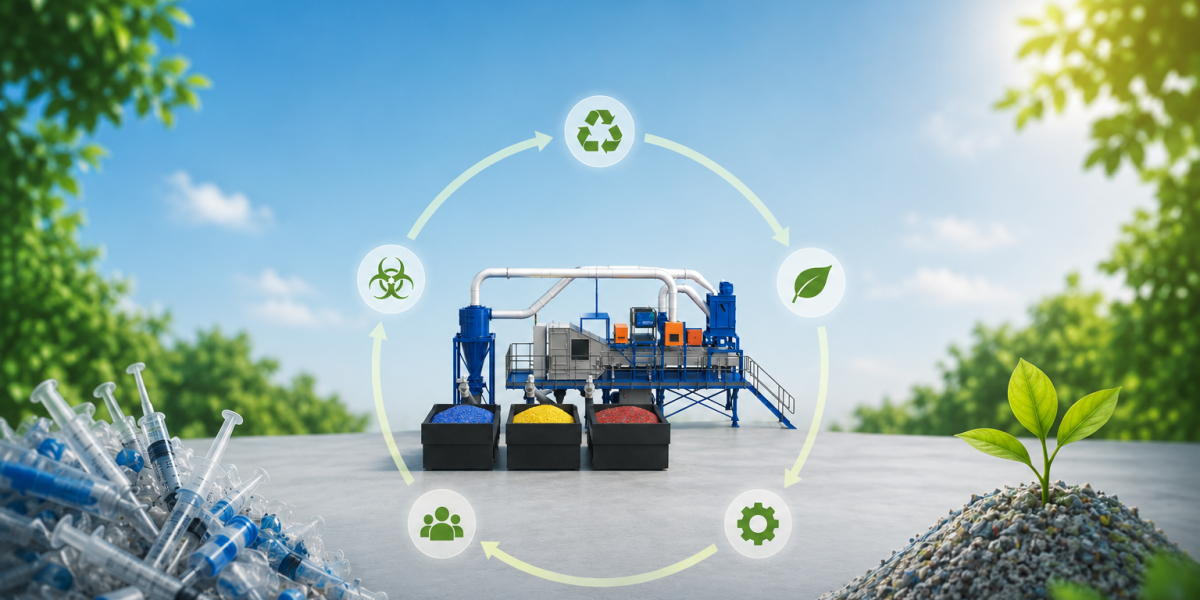
The healthcare sector generates growing volumes of medical waste, driven by rising patient numbers and the widespread use of single-use materials. Some of this waste is infectious and must be disinfected before any disposal. For decades, the default response was incineration, sometimes uncontrolled, at the bottom of a garden. Today, the innovation debate often focuses on the digital side: sensors, connected containers, dashboards. These tools are useful, but they measure the waste more than they treat it. The real environmental breakthrough lies elsewhere: decontaminating without burning, then transforming infectious waste into a dry, recyclable material.
Table of Contents:
- A volume of waste that weighs on the climate
- The first wave of innovation: digital, sensors and traceability
- The real breakthrough: decontaminating without combustion or water
- From decontamination to recycling: the circular economy in action
- What about digital at Ecosteryl?
- Limiting the handling of infectious waste
- Comparison of the main treatment methods
- Frequently asked questions
A volume of waste that weighs on the climate
Statistics indicate that around 85% of medical waste is considered non-hazardous; the remaining 15% is infectious, toxic or at risk, and requires specific treatment. The healthcare sector is also estimated to account for nearly 4.4% of global greenhouse gas emissions according to the organization Health Care Without Harm, which would make it one of the main contributors worldwide. Gloves, syringes, tubing and plastic packaging, derived from petrochemicals, release CO₂ and other pollutants when they are incinerated or landfilled. Reducing this footprint therefore means rethinking not only collection, but above all the method of treatment.
The first wave of innovation: digital, sensors and traceability
A large part of recent innovations focuses on data. Connected containers measure fill levels in real time and integrate with hospital IT systems to trigger alerts and optimize pickups. AI-assisted sorting systems aim to better separate hazardous and non-hazardous streams. These advances improve traceability and safety, and cut down on unnecessary trips. They represent real progress. But they share a limitation: they help track and organize the waste, without neutralizing it or giving it a second life. For that, it is the treatment process itself that must evolve.
The real breakthrough: decontaminating without combustion or water
This is where microwave treatment comes in, a 100% electric alternative to incineration. Ecosteryl’s principle? The waste is first shredded by a 4-shaft industrial shredder to reduce particles to less than 35 mm. It is then heated to around 100°C within a few minutes in a microwave tunnel. The waste is then held for close to an hour at 100°C in a vessel. This process ensures 6log10 disinfection, meaning a 99.9999% reduction of micro-organisms.
The environmental benefit is twofold. On the one hand, treatment takes place without combustion and without water, which limits emissions and regulatory constraints compared with an incinerator or an autoclave. On the other hand, the waste comes out reduced by around 80% in volume, dry, unrecognizable and recyclable. Microwave treatment is also more energy-efficient, requires little manual intervention and remains fast.
From decontamination to recycling: the circular economy in action
Decontaminating is no longer enough. The next question is: what becomes of the material once it has been treated? This is precisely where Ecosteryl takes innovation a step further with R-steryl, a sorting and recycling center for decontaminated waste. Once dry and harmless, the waste is no longer an end of the chain but a resource: plastics from healthcare can be recovered and reintroduced into a recycling stream. This shifts the logic from disposal to circular economy.
This approach reflects a fundamental trend. More and more hospitals are adopting circular strategies, recognizing that a large part of their waste is in fact made up of recoverable non-clinical materials. Turning infectious waste into recyclable material is not a token argument: it is the logical outcome of a treatment that leaves the waste dry and with good particle size.
What about digital at Ecosteryl?
Digital is not absent from this approach: it is its complement. The machines integrate sensors and allow treatment data to be monitored, useful for management, maintenance and compliance. The difference in approach can be summed up in one sentence: data comes to support a process that genuinely transforms waste, rather than being the innovation on its own.
Ecosteryl naturally follows this trend, having for long equipped its machines with the best sensors to make them as automated as possible. The case of Rennes University Hospital (CHU de Rennes), which no longer even touches the infectious waste, is yet another example of innovation.
Limiting the handling of infectious waste
Another area of progress concerns the safety of teams. The more infectious waste is handled, the greater the risk of exposure. The most advanced approaches therefore aim to minimize human handling, from collection to treatment, and to automate the most sensitive stages of the chain.
The partnership between Envac and Ecosteryl made it possible to provide Rennes University Hospital with an automated infectious waste disinfection system. The waste is vacuumed away in 20 seconds and sent to a specially adapted Ecosteryl unit. This technological feat places Rennes University Hospital at the forefront of “zero contact” and the ecological treatment of infectious healthcare waste (DASRI).
Comparison of the main treatment methods
Each method addresses different constraints. The table below summarizes their main principles.
| Method | Principle | Strengths | Limitations |
|---|---|---|---|
| Incineration | High-temperature combustion | Burns almost everything | CO₂ and pollutant emissions, costs, regulatory constraints. Bottom ash. |
| Autoclave | Pressurized steam | Effective on many types of waste | Water treatment required. Significant operating costs. |
| Microwave (Ecosteryl) | Shredding then heating to ~100°C, 100% electric | No combustion or water, waste reduced by ~80%, dry and recyclable, energy-efficient | Equipment needed if working inside the shredder. |
Frequently asked questions (FAQ)
What alternative is there to incinerating medical waste?
Microwave treatment is a 100% electric alternative. The waste is shredded and then heated to around 100°C, without combustion or water, which reduces emissions compared with an incinerator.
Can medical waste be recycled?
Yes, it can be recycled once decontaminated and dry. With a center like R-steryl, plastics from healthcare can be sorted and reintroduced into a recycling stream, following a circular economy approach.
How does microwave treatment work?
The waste is shredded into fragments smaller than 35 mm, preheated by microwaves to 100°C, then held at around 100°C for close to an hour. The process ensures 6log10 disinfection, meaning a 99.9999% reduction of micro-organisms.
Is microwave treatment more environmentally friendly than incineration?
It works without combustion or water and in a 100% electric way, which reduces emissions and regulatory constraints. The waste also comes out reduced by around 80% in volume and is recyclable.
In summary
Innovation in medical waste treatment is not just about connecting containers or multiplying sensors. These tools have their uses, but they accompany waste without transforming it. The real turning point is environmental and industrial: decontaminating without burning, then recovering the material instead of disposing of it. It is this combination, 100% electric treatment and circular economy, that shapes the future of the sector.