

A sustainable hospital
How a French hospital reinvented infectious waste management with a fully automated, 100% electric Ecosteryl-Envac solution
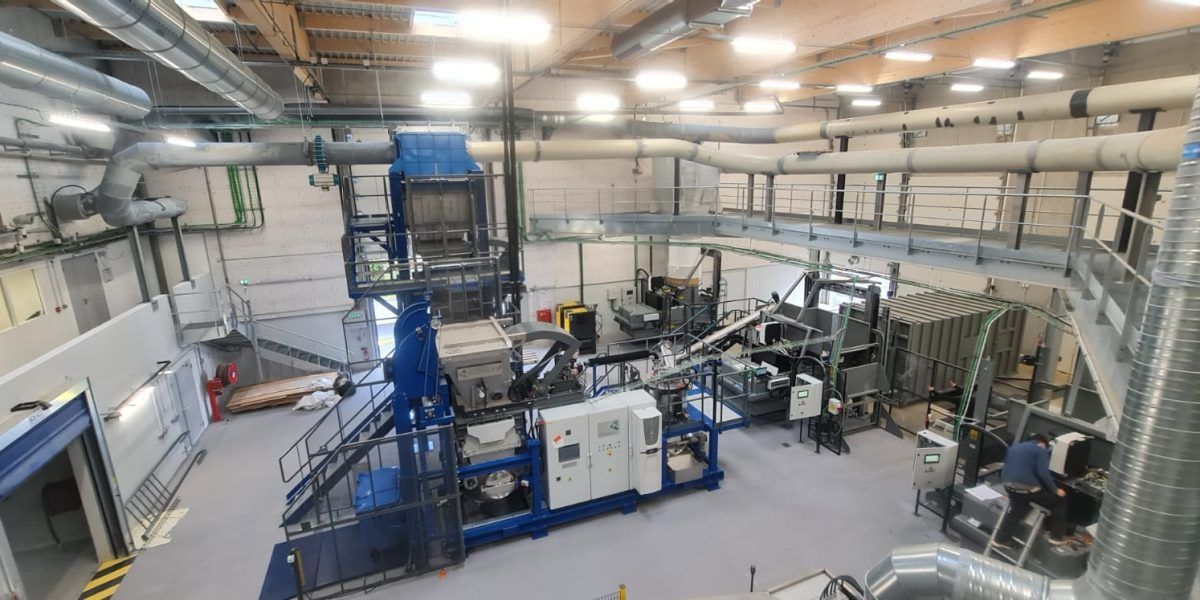
Hospitals worldwide are looking for safer, cleaner, and more sustainable ways to treat infectious medical waste (also known as clinical waste, regulated medical waste or hazardous healthcare waste). In March 2025, Rennes University Hospital (CHU de Rennes) became the first facility in the world to commission an automated, contact-free system combining Envac’s pneumatic waste collection technology and Ecosteryl’s microwave-based waste disinfection technology.
The result: infectious waste is collected, transported, shredded and disinfected on site in under 20 seconds without human handling and without combustion. This pioneering installation is already setting a new benchmark for hospitals planning futureproof waste infrastructure.
Table of contents
-
-
- A world first in automated infectious medical waste treatment
- How the automated infectious healthcare waste system works at Rennes University Hospital
- Inside the Ecosteryl automated disinfection module
- Environmental and operational benefits for hospitals
- A model for the next generation of smart, sustainable hospitals
- Protecting health and the environment with fully electric waste disinfection
-
A world first in automated infectious medical waste treatment
Rennes University Hospital has introduced a fully automated system for treating infectious medical waste, developed specifically for the facility. Waste is collected directly at the source, transported through Envac’s high-speed pneumatic network, and fed automatically into a customised Ecosteryl disinfection machine.
This installation positions Rennes as a global pioneer in zero-contact medical waste management and low-carbon, fully electric disinfection technology.
How the automated infectious healthcare waste system works at Rennes University Hospital
Across the hospital, each floor is equipped with separate chutes for linen, general waste and infectious medical waste. Each chute has its own secure access control. Once a bag of infectious waste is deposited, the system immediately sucks it into the stainless-steel pipeline, accelerates it to nearly 70km/H, and propels it through 350 metres of underground galleries designed by Envac.
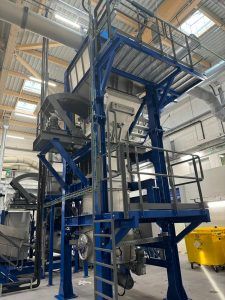
Connection system between Envac’s pneumatic network and the Ecosteryl disinfection module
The bag reaches the hospital’s logistics area in less than 20 seconds, where a dedicated Ecosteryl machine awaits. this approach eliminates manual handing and streamlines waste logistics within the hospital.
Inside the Ecosteryl automated disinfection module
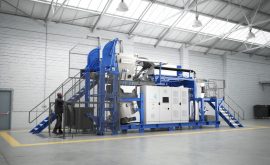
To support such a continuous, high-speed flow of infectious waste, Ecosteryl’s R&D team designed a custom module attached to an Ecosteryl 125 unit.
The connected module includes: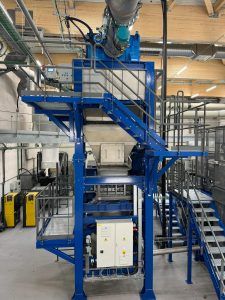
- Smart sensors to synchronise the incoming flow and ensure uninterrupted, safe operation.
- An adapted feed hopper and a pre-shred tank to absorb peaks and homogenise waste.
- A powerful industrial shredder reducing waste in volume to ensure optimal dry heat disinfection and complete pathogen inactivation (Discover why pre-shredding is so important for infectious healthcare waste proper disinfection).
Result : the treatment is fully electric and produces no harmful emissions. Processing capacity: minimum 125Kg/hour, zero manual handling, zero external transportation and, zero combustion.
“We designed a flexible machine able to absorb irregular loads while maintaining maximum sealing and safety”, explains Antoine Mouchati, Head of R&D at Ecosteryl.
Environmental and economic benefits of automated medical waste treatment
Since its launch, hundreds of tonnes of infectious medical waste have been processed directly on site at Rennes University Hospital.
Key outcomes:
- 80% reduction in waste volume
- Elimination of external transport for infectious waste
- Significantly reduced operator exposure risk
- Lower environmental footprint
- Lower waste management costs, especially transport and storage
The data confirms the relevance of a local, electric and contact-free treatment model.
A model for the next generation of smart hospitals
The success of this project is already influencing the design of new hospitals. Several facilities are studying similar configurations for new builds or major renovations.
This shows that automated infectious medical waste sorting and low-emission disinfection technologies are no longer futuristic ideas but operational solutions available today.
For Ecosteryl, this project reinforces a longstanding conviction: medical waste should be treated locally, without combustion, with robust electric technology that adapts to each hospital’s needs.
Protecting health and the environment with fully electric medical waste disinfection
Rennes did not merely open a new hospital; it introduced a new way of managing infectious healthcare waste.
With forward-thinking engineering and strong collaboration, the hospital demonstrates that safety, efficiency and sustainability can coexist.
What if other healthcare institutions also aspired to this ecological and economic revolution?
This solution combines maximum safety, logistical efficiency, and environmental responsibility, paving the way for more sustainable and intelligent hospitals. The Rennes model demonstrates that it is possible to reconcile innovation, public health, and ecological responsibility.
For newly established healthcare facilities, it is an invitation to integrate this solution directly at the architectural design stage.
FAQ
What is automated infectious medical waste treatment?
It refers to a system where infectious healthcare waste is collected, transported, shredded, and disinfected without manual handling. The process improves safety and complies with strict hospital hygiene regulations.
How fast is the pneumatic transport system used in Rennes?
Bags are transported at nearly 70 km/h through stainless-steel pipes, reaching the disinfection unit in under 20 seconds.
Does automated medical waste treatment reduce contamination risks?
Yes. Eliminating manual handling greatly reduces exposure risks for hospital staff, particularly in high-volume departments.
What type of technology does Ecosteryl use for disinfection?
Ecosteryl machines use fully electric microwave-based disinfection, without steam, chemicals, or combustion.
Can this system be installed in existing hospitals?
Yes. The solution can be integrated into existing infrastructures or included directly in the design of new hospitals. Contact us for a custom approach of your project.
What happens to the waste after disinfection?
Waste comes out dry, disinfected and reduced in volume, making it easier to sort, handle and prepare for local recycling streams.
Is shredded medical waste safe to process further?
Once disinfected, the treated waste is non-infectious and compliant with national and international regulations for healthcare waste management.
How much can hospitals reduce their environmental impact?
By treating waste locally with a fully electric process, hospitals cut transport-related emissions and avoid the pollution generated by incineration.
What is the difference between Ecosteryl and an autoclave?
Autoclaves use steam and pressure; Ecosteryl uses microwave energy, operates without water or combustion, and requires less maintenance for continuous throughput.
Who can provide support for installing these systems?
Hospitals, governments and private waste operators can contact Ecosteryl for technical studies, on site assessments and tailored installation plans.
To learn more about or medical waste treatment solutions, discover the Ecosteryl range or contact our team at sales@ecosteryl.com.
We would be delighted to discuss with you the sustainable hospital projects of tomorrow.